
Thursday, October 18

Gender equality: Hierarchy of rights or separating state and faith?

Annie Lessard (a Montreal human rights activist) writes in The Suburban:

The Quebec Council on the Status of Women (CSF) has called for gender equality without compromise to any demands based on freedom of religion. The Montreal Multicultural Women’s Coalition denounced this position, seeing no less than a “frontal attack” against Quebec’s ethnic minorities.

It is not the CSF that should be denounced, but the rhetoric of cultural relativism that sees in the primacy of gender equality an attack against the culture or religious beliefs of minorities.

There are some, particularly those representing the coalition, who denounced the recent advisory report of the CSF entitled “The Right to equality between women and men and freedom of religions.” The CSF recommended adding to the Quebec Charter of Rights and Freedoms a provision clearly stating that equality between men and women can not be compromised in the name of freedom of religion. The advice of the CSF also contains the following recommendations:
  • That government officials (including teachers) cannot display ostentatious religious signs while at work;
  • That the Education Act provides that education policies should emphasize the values of equality between men and women and that these values should not be set aside based on religious or cultural considerations.

Critics of the CSF assert that this is a “hierarchy of rights”, relegating religious freedom to second-tier status, contrary to international law and the Canadian constitution. As for the “hierarchy of rights”, they create a red herring. The international law of human rights establishes an undeniable hierarchy of rights. There are many conventions whose purpose is precisely to fight against the exploitation of women and girls by religious and cultural creeds. As for the Canadian Charter of Rights, it contains a specific provision guaranteeing equality between men and women. This provision is in addition to the provision prohibiting discrimination on the basis of gender. This additional provision (section 28) reflects a Canadian value that is so fundamental that it takes precedence over all other provisions of the Canadian Charter, including those guaranteeing freedom of religion and the promotion of Canadian multiculturalism. Section 28 was added to the Canadian Charter in 1982 at the insistence of women’s groups who were concerned that the new constitutional provision on the promotion of our multicultural heritage should not be used as a legal justification for the unequal treatment of women. Furthermore, section 28 is shielded from the “notwithstanding clause”. No province or the federal government may derogate from it.

Many critics of the CSF position are representative of those cultural relativists and multiculturalists who see in our conception of human rights and secularism an ideological instrument of the West promoting an ethnocentric, neo-colonialist and racist vision of society.

The reality is that a State which promotes gender equality must be consistent in its practices and representations. The veiled teacher promoting the values of equality between women and men poses, both at a symbolic and educational level, a conflict of representations. The underlying message, hidden under the Islamic headscarf, is that of women seen as vile and polluted beings taking moral responsibility for keeping men’s purity in check. We cannot, under the guise of respect for cultural differences and religious beliefs, legitimize inequality and endorse, at the symbolic level, archaic representations of women. For our institutions to accommodate, in the name of multiculturalism, the paradigm of subordination of girls and women or archetypal representations of women as seductive temptresses is tantamount to State-endorsed racism.

The Montreal Multicultural Women’s Coalition may choose to see, in the position of the CSF, a manifestation of the “tyranny of the majority”. But in fact, the ultimate challenge is the protection of our freedoms from the “triumph of the mediocre”

Wednesday, October 17

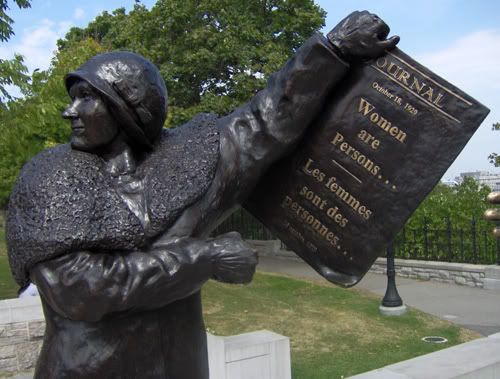
The 80th anniversary of the Persons Case

John F. Kennedy once noted that "Things do not happen. They are made to happen."

This week in Canada, we celebrate a classic example of that truth: The Persons Case.

Eight decades ago, five feminist activists from Alberta appealed a decision by the Supreme Court of Canada that women were not persons under the law. On Oct. 18, 1929, England's Privy Council overturned the decision.

The Canadian government didn't easily decide to declare women persons, grant us the vote, or bring in laws to prevent employers from firing us once we got married.

Women themselves made those equality gains happen, just as they continue to today: Sacrificing time and income to make sexual assault and divorce laws fairer, to improve the matrimonial rights of aboriginal women, to secure maternity benefits and fair pay.

In the '60s, women fought to ensure we'd have legal access to birth control. In the '80s we fought to make it a criminal offense for a man to rape his wife. And, as recently as 2005, we fought to prevent the use of sharia law in this country.

Here are just a few of the changes that I and many other women believe are necessary for Canada to truly deserve its reputation:

  • We'd like the words of our national anthem to include us. We'd like daughters to be as cherished as sons, and raised as if they might one day fly to the moon or run the country
  • We'd like it to be unthinkable for a lingerie company to promote thong underwear and push-up bras to seven-year-olds.
  • And we'd like the news coverage of violence against women to challenge, not perpetuate, rape myths.
  • We dream about a time when women can "take back the night" the other 364 days a year.
  • When we have more chance of winning the lottery than being murdered by our spouse.
  • When the conviction rate for sexual assault is high enough to deter men from pretending that "no" means "knock her unconscious first."
  • We'd like the picture of Canadian power to look more like us, in all our diversity. For women to be equally represented in Parliament, not lagging behind Rwanda and Iraq with only with 21 per cent of MPs.
  • We believe that if women were actively recruited, supported, and allowed to run in ridings where they had a genuine chance of winning, then maybe our governments would get tough on the roots of social problems, not on the symptoms of crime.
  • Certainly the degree to which our collective economic future depends on women's willingness to sacrifice their physical and economic health to create future taxpayers would be clearer. The indispensability of a national child-care program would be a given, and fewer children would suffer from the constraints of poverty.

These changes would continue the tradition that the Famous Five began. And they would benefit all Canadians. Studies from around the world make it clear that economic prosperity follows social equality.
When women are educated, given genuine choice around child rearing and employment, treated with respect, paid fairly and protected from violence, the entire society benefits.
We all have a vested interest in making it happen.
Media critic and author Shari Graydon will receive a Persons Case award this week for her advocacy work as president of MediaWatch and the Women's Future Fund.
LINK: Vancouver Sun

Why abused women stay

Anyone who has ever wondered why abused women don't just leave their partners should talk to abused women in rural areas.

Deborah Doherty and Jennie Hornosty of Fredericton have done just that. Their study, funded by the Canada Firearms Centre, looked at the experiences of rural abused women.

Their research would be of great interest to New Brunswick even if it had been conducted in another part of Canada, but it was done mostly with New Brunswick women. With half of us living in non-urban areas, and with New Brunswick having such a high rate of gun-related deaths and spousal murder-suicides, we should be paying attention to their results and recommendations.

New study reports that rural abusers threaten their spouses with firearms and with threats or actual harm to animals.

Fortunately the two researchers have embarked on a short tour of the province — soon in Caraquet, Cambpellton and Woodstock — to let rural New Brunswick know about their findings.

We can imagine some of the problems particular to living in a rural area: isolation, poverty and transportation. Many abused women also mentioned police response times — one said when you see two police cars going in one direction in a rural community, you know you can do anything you want in the other direction.

Many also talked about how traditional values, strong in some rural areas, mean that women are supposed to be submissive and that reporting abuse would stigmatize them and their families.

And then there are the guns and animals, both frequently present in rural areas, and, the researchers found, both used as instruments of control, intimidation, and abuse in family violence situations.

Even crisis and victim service workers who participated in the study were amazed at the responses of abused women when asked about the use of firearms and threats to animals. The workers later strongly recommended that these questions become standard on risk assessment and in-take forms.

Almost half of the abused women said that their partner had threatened to harm animals as a means of controlling her. "He would threaten to kill the dog, and describe the dog's death very violently, it was really graphic." Most said their partner had actually harmed or killed an animal. It was common for the women to delay seeking help out of fear for their animals, and because there is no safe haven for these animals.

One woman who owned horses explained that when her partner's abusive behaviour towards her became intolerable, she would end up staying or going back because she had to feed the horses. "Where can you go with a horse or chickens or sheep?" she asked rhetorically.

In homes where firearms were present, two-thirds of the women said knowing about the firearms made them more fearful for their safety. Most of the women said it affected their decision to ask for help, especially if the firearms were not licensed, registered or locked. Indeed, even some family, neighbours and service providers who witness abuse were made too scared to call the police by the knowledge that firearms were present.

Some spoke of actual assaults with a gun, including rape with a gun to their head. But threats can be subtly effective in the context, as is the fact that a gun is always loaded, or always on top of the fridge. As one focus group participant said, "All he has to do is look over at the bed and she knows there is rifle underneath and that she had better do what he says."

In a province with a "hunting" or "gun culture", there can be a cavalier attitude to firearms, to their storage and to their potential lethality even where there is family violence and other problems.

Incredibly, the study found that unless a domestic violence incident specifically involved a firearm, police don't usually search for and seize the firearms in a home where they have answered a call. Some rural abused women said they do not trust that their problem will be taken seriously if they disclose the abuse. Others said that when they do disclose firearms misuse to service providers, often there is no follow-up.

Some did not dare tell police or others about the guns in the home because they were not sure the guns would be taken away. If they were, she was in for a beating, and if they weren't, it could get even worse.

Some women were frightened of calling the police because so many rural people have scanners to listen to police calls. Given perceived police response times, it's not just the shame of their neighbours knowing their business, it's the fear that a neighbour will tell the abuser. Some imagined that if police came to take away his guns, it would end in a standoff.

Dr Doherty and Dr Hornosty heard heart-wrenching stories of women who stayed out of fear for their lives. They heard over and over that if she tried to leave, he had said he would shoot and bury her and no one would ever know or even hear the shot, given where they lived. Some women stayed because their children were so attached to the animals that were being threatened.

Women who eventually left said that some interveners told them they were stupid for having hesitated because of animals. When you are being terrorized and trying to react sanely to an insane situation, you don't need "helpers" to tell you that you are stupid. Even people who understand about women and kids can lack concern about pets, or don't believe anybody would hurt an animal.

Add mental health problems and drugs including alcohol to the situations above, and you can imagine the paralyzing fear that women live with on some farms and rural homes in the province. We have much to do to reach out to them.

Ginette Petitpas-Taylor, of Moncton, is Chairperson of the New Brunswick Advisory Council on the Status Of Women. Her column on women's issues appears in the Times & Transcript every Thursday. She may be reached via e-mail at the eddress beloq.


Related addresses:
StraightGoods
eMail 1: acswcccf@gnb.ca

Fighting Harper with a dose of his own medicine

Given a political foe that plays to the limit of the law, women’s advocates can adopt the same approach.


Tom Flanagan, one of Stephen Harper’s closest advisors and three-time national campaign manager, is currently doing publicity for his new “insider’s” book on Harper’s government and rise to power.

If equality-seeking groups are paying any attention to Flanagan, it is unlikely they are doing so for political advice. Yet recently Flanagan, on CBC Radio’s The House, provided such groups, including progressive women’s organizations, with some of the most useful insights on how to advance an equality agenda and a women’s agenda under the Harper government.

Flanagan calls funding cuts to Status of Women Canada and the elimination of the Court Challenges Program a “nice step,” asserting without equivocation that Conservatives will “defund” all equality-seeking groups – with feminists at the top of the list.

He goes further, clarifying that Conservatives also plan to choke-off these groups’ supposedly privileged access to government by, for example, denying “meetings with ministers.” But for strategic reasons, Flanagan notes, this will all happen incrementally. To avoid the perception of mean-spirited retribution, he says, “incrementalism is the way to go.”
read more at rabble.ca

Tuesday, October 16

Throne Speech slams the door on National Child Care Program

It is news to Canadian families that Stephen Harper’s government has delivered on child care, say child care advocates responding to tonight’s Throne Speech.

“Any parent knows that a $100 monthly voucher doesn’t create child care and without child care there is no choice,” says Morna Ballantyne of the advocacy group Code Blue for Child Care.

“Harper’s claim is particularly misleading given that the Tories have not delivered a single one of the 125,000 child care spaces they promised.”

The Throne Speech signals the Tories’ intention to strip Government of the legislative and financial leavers to protect and expand social programs. “Redirected to child care the proposed 1% cut to the GST would provide every child in Canada between 3 and 6 with a full time child care space,” said Ballantyne.

“Harper’s plan to legislate limits to the federal spending power demonstrates his continued hostility to social programs; a hostility he championed as head of the National Citizen’s Coalition and demonstrated when in his first act as Prime Minister he cancelled the child care plan negotiated with the provinces,” said Ballantyne. “The federal spending power is the


Constitutional mechanism that gave us Medicare. It is the only tool the Government of Canada has to launch a pan-Canadian child care program.”

The Tories are misusing Quebecers’ desire to control their own social institutions to cover their actions, says Jody Dallaire, Chairperson of the Child Care Advocacy Association of Canada. “But Parliament has all the practical tools it requires to both protect and expand social programs while respecting Quebec’s distinct status.”

Bill C-303, The Early Learning and Child Care Act, scheduled before Parliament this session does just that. It places conditions on provinces and territories that receive federal funding for child care but it also explicitly recognizes Quebec’s right to set its own standards. “Quebec’s needs can be addressed without imposing on all Canadians a measure that makes sense only for Quebec,” says Dallaire.

Ottawa last used its spending power for child care in 2005 when the then Liberal government signed bi-lateral agreements with the provinces on condition they report regularly and direct the money to regulated child care services. “Ottawa’s ability to set conditions on the funding it makes available for social programs ensures that Canadians from coast to coast to coast enjoy the same fundamental social rights,” said Dallaire.

For more comment contact:Morna Ballantyne, Co-ordinator, Code Blue for Child Care: 613-791-3411Sue Colley, Code Blue for Child Care: 416 538 1950/ cell: 647 224 4006Jody Dallaire, Chairperson, Child Care Advocacy Association of Canada: 506-878-8666Susan Harney, Vice-Chairperson, Child Care Advocacy Association of Canada: 604-888-8786
Click on the link below for a copy of the Media Release:
Code Blue for Child Care Throne Speech Response

Persons Day -- Thursday October 18th

The Ottawa Council of Women will hold a gathering at the Persons Monument on Parliament Hill to mark Persons Day on Thursday October 18th at 12 noon. All are welcome. Come out and show your solidarity with Equality Seeking Women's Organizations. Women's equality issues persist in Canada and the demand for sustained advocacy has never been greater. The Famous Five were determined. We must follow their example and support the aims and objectives of those who seek equality for women.

Bring your personal tea cup - tea will be served - and toast all of those Canadian women who have made history as advocates for women's equality with a cup'a.

The Famous Five or The Valiant Five were five Canadian women who, in 1927 asked the Supreme Court of Canada to answer the question, "Are women persons?" in the case Edwards v. Canada (Attorney General). Canada's Supreme Court essentially said in a unanimous decision - no they were not "qualified persons" - but this was overturned by the British Judicial Committee of the Privy Council. The case came to be known as the Persons Case.

The women, all of whom were from Alberta, were:

StatsCanOver two-thirds of persons who seek victim services are female

About 400,000 victims of crime sought assistance from 589 victim services agencies between April 1, 2005, and March 31, 2006, according to a new report.

These agencies reported having served about 161,000 female and 48,000 male victims. The victim's sex was not provided for the remaining 190,000 victims.

Data came from the Victim Services Survey (VSS), which enumerated a total of 830 victim service agencies and 9 criminal injuries compensation programs identified as providing formal services to victims of crime. While responses were received from 697 of these agencies, some agencies did not respond to certain questions because the information was either not applicable or not available.

Over two-thirds (68%) of victims who sought assistance on the snapshot day were female, roughly the same as in 2002/2003, when the survey was last conducted.

Among female victims who had experienced a violent crime, 53% had experienced violence by a spouse, ex-spouse or intimate partner. A further 24% had been victimized by a family member other than a spouse. The remaining 23% had experienced violence at the hands of a non-family member, such as a friend, a neighbour or a stranger.

The estimated cost of providing services to victims of crime, based on responses from 628 agencies, totaled $152.2 million in 2005/2006, excluding compensation programs.

The Juristat: "Victim Services in Canada, 2005/2006," Vol. 27, no. 7 (85-002-XIE, free) and the publication, Victim Services in Canada: National, Provincial and Territorial Fact Sheets, 2005/2006 (85-003-XWE, free), are now available from our website.

Eradicate poverty by 2015

Activists are mobilized around the world today to scold governments for falling short on promises to eradicate poverty by 2015, Sarah Seltzer reports today. Participants in women's tribunals will detail the female features of the shortfall and its solutions.

Seven years into the United Nations' 15-year effort to implement global antipoverty goals activists are urging worldwide governments to keep their promises and recommit to the eradication of poverty.

As part of this, millions on Oct. 17 are expected to join an annual day of global demonstrations spearheaded by the Global Call to Action Against Poverty, an alliance of international trade unions, nongovernmental organizations and other groups.In a Netherlands stadium performers will sing a "poverty requiem." In New Jersey, students from a charter school will recite an antipoverty pledge.

In Bangladesh, people will rally on the steps of parliament and Nigerian fans will stand for a moment of solidarity during a soccer match.

Organizers hope that when taken together the demonstrators will surpass last year, when they made the Guinness Book of World Records for the most people to stand up for a single cause on a single day: 23.5 million.

The day of demonstrations, which began last year, includes an emphasis on women's rights, on the premise that poverty is not combatable until females--who U.N. agencies agree represent 70 percent of the world's poor--are tapped as part of the solution. In the United States, nearly 60 percent of the people living below the poverty line are women, the U.S. Census Bureau reported in 2006.

The female aspect of poverty will be dramatized with a series of women's tribunals in countries such as Egypt, India, Malta and the United States where women will testify about the effects of poverty on their lives.

"What is going to happen is that stories will be told, but also the root of those stories is going to be analyzed: what is the cause, what can be transformed and what political measures need to be taken," says Ana Agostino, the Global Call to Action Against Poverty's co-chair and a coordinator of the group's Feminist Task Force.

Not Equal in OpportunityChris Grumm, president of the San-Francisco-based Women's Funding Network, which has teamed up with the United Nations Development Fund for Women to spearhead the project, says that "women are a huge part of the economic engine, but often not an equal part of economic opportunities.

For more information:

Stand Up! Campaign Home Page:
http://www.standagainstpoverty.org/
Global Call to Action Against Poverty:
http://www.whiteband.org/
Women's E-card to Fight Poverty:
http://www.womenfightpoverty.org/ecard/index.php

Monday, October 15

Feminism improves relationships

A new study out of Rutgers (represent) finds that feminism improves relationships. I knew it all along, but I'm glad that I have some smarties to back me up.

Their study* also shows that unflattering feminist stereotypes, that tend to stigmatize feminists as unattractive and sexually unappealing, are unsupported.

* Reference: Rudman LA & Phelan JE (2007). The interpersonal power of feminism: is feminism good for romantic relationships? Sex Roles (DOI 10.1007/s11199-007-9319-9)

Note: This story has been adapted from material provided by Springer. Read Original Article

Matrimonial Real Property: A People’s Report.

The Native Women’s Association of Canada held workshops across Canada last year concerning the issue of matrimonial real property on reserve, and the People’s Report is a detailed summary of what was voiced by Aboriginal women across Canada. The NWAC will be hosting a press conference to officially launch the report and to discuss the pending legislation and non-legislative issues.


Enforcing its call to mend a "legislative gap" that slights aboriginal women living on reserves, the Native Women's Association of Canada released a report Monday it says should give the government all the information it needs to fix the policy.

The NWAC is urging Ottawa to amend the law to give native women who live on reserves the same rights afforded to other Canadian women when they undergo broken marriages or divorces.

When a marriage breaks down in Canada, an ex-husband cannot, for instance, sell the family home without the consent of his ex-wife. Such is not the case for people who live on reserve land, where laws for the fair division of assets after failed marriages do not apply.

Under the federal Indian Act, which governs most aspects of reserve life, there is no mention of "matrimonial real property."
[Read More ]
People's Report: "What We Heard"

Child Care Advocates Keeping An Eye On The Throne Speech

Child care advocates will be closely monitoring Tuesday's Speech from the Throne to see if Stephen Harper allies with Gilles Duceppe to limit the federal spending power. The federal spending power is the only available tool the Government of Canada has to launch a pan-Canadian child care program.

"This constitutional provision is the mechanism that gave us Medicare,"
says Morna Ballantyne of the national advocacy group Code Blue for Child Care.

"Ottawa's ability to set conditions on the funding it makes available for social programs ensures that Canadians from coast to coast to coast enjoy the same fundamental social rights."

Child care advocates respect the desire of Quebecers to control their own social institutions as a means of protecting their distinct culture," says Ballantyne. "But Quebec's needs can be addressed without imposing on all Canadians a measure that makes sense only for Quebec."

Bill 303, The Early Learning and Child Care Act, scheduled before
Parliament this session does just that. It places conditions on provinces and territories in receipt of federal funding for child care but allows Quebec to set its own standards.

"The federal spending power is essential if all Canadian parents and
children are to enjoy access to the same level of child care available to Quebec families," says Jody Dallaire, Chairperson of the Child Care Advocacy Association of Canada.

Ottawa last used its spending power in 2005 when the then Liberal
government signed bi-lateral agreements with the provinces for child care on condition they report regularly and direct the money to regulated services.

"Stephen Harper demonstrated his hostility to national programs when in his first act as Prime Minister he cancelled the child care agreements and has since reneged on his own promise to create 125,000 new spaces," said Dallaire.

Friday, October 12

Out of the Kitchen, Cooking Up Equality

The cookbook - Out of the Kitchen, Cooking Up Equality - is rolling off the presses this week !!!


There is a kit for taking your cookbooks to events such as conferences and conventions. The kit includes order forms, stickers, and cooking props to make an eye-catching display.

The English cookbooks will be available for shipping early next week. If you order now, the Adhoc Coalition For Women's Equality can have them shipped directly from the printer.

Send an email to place your order.