Monday, December 11

CAW Urges Activists To Fight Right Wing Attack On Women's Rights

Carol Phillips (Assistant to CAW National President): "I want you to expect; I want you to create; I want you to participate in spontaneous acts of rebellion at an increasing pace as we remind these reformers, this really is the Reform Party that we are dealing with here, these Reformers in Conservative clothing, just how much is at stake here."

To view the complete video from the CAW website, click here

Sunday, December 10

Video and Media Coverage

CTV news video is here
CTV print coverage is here

65 Photos

65 photos were uploaded to photobucket and a slideshow can be viewed here

1000 women and their allies gathered Sunday for a rally at the Supreme Court of Canada


1000 women and their allies gathered Sunday for a rally at the Supreme Court of Canada to draw attention to one Tory cut - the abolition of a program that helped women pay for lawsuits defending their equality rights.

"This government is trying to shut us out of access to justice, trying to silence women's advocacy, but we will not accept to be silenced," said Andree Cote of the National Association of Women and the Law.

The coalition wants the funding cuts restored but doesn't stop there. It's also pressing for increased spending on day care, and for stronger legislation to guarantee pay equity between men and women.

The Ottawa event capped a weekend of protests by groups across the country.


Saturday, December 9

Sunday December 10th - Ottawa Rally and March

On December 10th, International Human Rights Day, Canada will mark the 25th anniversary of its ratification of the UN Convention on the Elimination of all Forms of Discrimination against Women (CEDAW).

Instead of celebrating this historical milestone, women in Canada are mobilizing to ensure that governments honour and respect their international and domestic human rights commitments.


This is because over several months now, the federal government has acted in ways that deny most women’s realities, undermine women’s access to justice, and abandon its own obligation to advance women’s human rights in Canada.

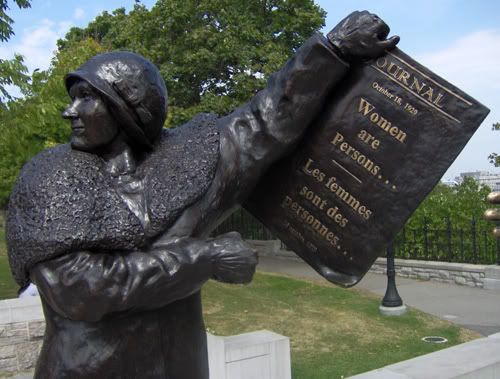
Women from the Montreal, Toronto and Ottawa area will gather in front ofthe Supreme Court of Canada at 1:30 pm and march to the Famous Five Women'sMonument on Parliament Hill to demand that Prime Minister Stephen Harper honour his election commitment to uphold women's equality and human rights.

Events Elsewhere:

  • Women Nobel Peace Laureates send a letter to Prime Minister Harper : "We women Peace Laureates of the Nobel Women’s Initiative are writing to express our concerns about recent decisions which may jeopardize the historic efforts by Canada to achieve women’s full equality, at home and abroad. On December 10th, International Human Rights Day and the 25th anniversary of Canada’s ratification of the Convention on the Elimination of All Forms of Discrimination, we will stand in solidarity with women’s organizations across Canada in urging you to honour and respect international and domestic human rights commitments."

  • PEI women say:""Every Canadian woman, mother, grandmother,sister, aunt, niece, daughter and granddaughter who is not already suffering from the reign of cuts to social programs and health care is about to feel thesting of those cuts," says Donalda MacDonald, CUPE Regional Vice-President from Prince Edward Island.

  • NL women's groups take action

  • NWT bra burning “Harper has kicked women back to the sixties and we have a fitting response”. The Yellowknife Women’s Society is hosting a good, old fashioned bra burning event this Sunday in front of the Greenstone federal building.

  • "Not In Our Name, Mr. Harper!" at Moncton NB City Hall

  • The Ontario Federation of Labour (OFL) is asking all its affiliated unions, advocates and activists to call the Premier's Office and tell them that muzzling the voices of people who need human rights protection the most is not okay, write letters to the editor in your own home town and lobby your local MPP. They are also asking their affiliates and community partners to join them in Ottawa on December 10 at 1:30 p.m. at the Supreme Court of Canada where women will rally and march for Women's Human Rights, for equality, for access to government and the courts.

  • Letter Writing Campaign Alberta
    Who? YWCA Calgary
    What? Letter writing campaign to Prime Minister Stephen Harper in protest of status of women cuts and changes in terms and conditions
    When? December 10th

  • Bus to Ottawa from Montreal
    Who? La Fédération des femmes du Québec
    What? Two buses to Ottawa from Montréal
    When? Sunday, December 10th, 2006

  • Bus to Ottawa from Toronto and back
    Who? Ontario Association of Interval and Transition Houses OAITH
    What? Bus to December 10th Rally on Parliament Hill!
    Where? Meeting place: Gather on December 10th at 8:45 am at 2 Carlton Street (corner of Carlton and Yonge Sts) in downtown Toronto.When? Leaving Toronto for Ottawa: Sunday, December 10th at 9 am sharpRally in front of Supreme Court, Ottawa at 1:30 pmReturning to Toronto: Sunday, December 10th at 4 pm sharpWe should be back in Toronto by 9 pm

  • Women Walking Together Saskatoon
    Who? Iskwewuk E-wichiwitochik (Women Walking Together)
    What? Brunch/Entertainment, DVD airing of “Highway of Tears”,Vigil/Remembrance, speakers talking about the cut backs and their affect on Aboriginal women in Canada
    Where? White Buffalo Youth Lodge, 602 20th Street West, SaskatoonWhen? 12:00-3:00pm, December 10th

Two Minute Action on the Closures

The Conservatives have announced that they will close 12 of 16 Status of Women Canada offices in 8 provinces.

What you can do today:

Support the PSAC members working at SWC. Send them an email! Close to 40 PSAC members will be losing their jobs on April 1 st , 2007 . Others will remain in place and do their best to fulfill SWC's mandate. Tell them we appreciate all their work on behalf of all Canadian women. Let them know we believe in women's equality. Let them know we are fighting back


What do the closures means for women ?

  • 61 out of 131 positions are being cut, effective April 1, 2007 . The majority of these positions are held by PSAC members. Pink slips have started arriving at SWC offices across the country.
  • The new senior management team is being reduced from 7 to 6. A new Deputy Coordinator position is being created.
  • 12 out of 16 regional offices are being closed in the following communities: Vancouver , Saskatoon , Winnipeg , Thunder Bay , Toronto , Hamilton , London , Ottawa , Ste-Foy, Halifax , Charlottetown , St. John's.
  • Status of Women Canada's regional presence will be limited to four “points of service”: Edmonton , Ottawa (at Headquarters), Montréal and Moncton.
  • Regional office staff will no longer represent SWC on federal councils and other government initiatives. They will no longer have the mandate to liaise with their provincial and territorial counterparts. Their mandate to provide information to the general public will be limited. Their technical assistance to women's groups will be limited to priority groups – Aboriginal and immigrant women.
  • The federal government's in-house expertise on women's policy issues is being lost.
  • SWC staff have worked hard on behalf of all Canadian women from coast to coast to coast. They are program officers, researchers, policy analysts, communications experts, managers, administrative and support staff, and technical staff.

Two minute Action on Status of Women Funding

The Conservatives have cut Status of Women’s budget by 40% and eliminated funding to women’s groups who advocate for equality

What you can do today:

Send an email to Stephen Harper and let him know that his government's recent announcements are a departure from Canada’s long-standing commitment to the promotion of women’s equality and human rights and that you strongly disagree with this direction. Click here

What do the funding cuts mean to women?

  • The Terms and Conditions (T & Cs) of the Women’s Program (WP) have been renewed for the period September 27, 2006 to September 27, 2011.
  • Significant changes have been made to the Women’s Program’s mandate, objectives, eligibility criteria and activities NOT funded. Women’s equality, social justice, political and legal participation of women are examples of the language which has been erased from the T&Cs.
  • All activities linked to advocacy, lobbying and most research have been excluded from the new T&Cs. It is for this reason that a significant number of equality-seeking women’s groups, especially though not exclusively those working at the national level, will find it extremely difficult to secure funding through the Women’s Program. (ie NAWL, FAFIA etc)
  • The current T&Cs aim to provide “direct” and “local” assistance. This is very much based on a charity model which ignores the systemic issues behind the problem at hand. Instead of providing analysis and aiming for legal change the current approach privileges a case by case basis, almost as if women’s poverty and violence against women were exceptions, aberrations to the norm. This approach is not meant to result in any significant change and does not challenge the status quo.
  • Local work clearly needs to happen. However the women providing local services, often with little pay and job security cannot be expected to add advocacy work to their plate. Women’s equality work must also take place at the policy, research, legal and lobbying and advocacy levels. Providing short term services will not address long term, systemic discrimination issues which allow women’s poverty and violence against women to prevail.

Two minute action on the Court Challenges Program


The Conservatives have cancelled the Court Challenges Program so women can’t fight discrimination

What you can do today:

The Court Challenges Program has been cancelled by the Conservative minority government. This is a blow to all those in Canada who believe in fairness, equality, and language rights for French and English minorities. Please help reverse this decision.
Send email to your MP
Send email to the Prime Minister
Tell your friends about this campaign

What does the end of the Court Challenges Program mean for women?

  • On September 25 2006, the Harper government announced that it would immediately end all funding for the Court Challenges Program of Canada. This is a bad decision for women, and it must be reversed.
  • The Court Challenges Program (CCP) is a very important program that funds test-cases initiated by individuals and groups to challenge federal laws and policies that violate their constitutional equality rights. With the help of CCP funding, women’s organizations and other equality-seeking groups have been able to access the justice system, and present progressive interpretations of the law. This has resulted in more egalitarian outcomes for women, gays and lesbians, persons with a disability and other disadvantaged groups.
  • For example, the CCP provided funding for the Women’s Legal an Education Fund (LEAF) to argue against the use sexists myths in sexual assault trials. LEAF intervened before the Supreme Court of Canada in the Ewanchuk case, where the accused argued that the way a woman is dressed for a job interview can imply that she consents to having sex with a potential employer. Fortunately, the Supreme Court agreed with LEAF arguments and rejected this sexist defense.
  • The Court Challenges Program also funds test cases to defend the language rights of francophones outside of Québec and anglophones in Québec. This funding has been crucial in the struggle of francophones across Canada to obtain French language schools, and health care services in French.
  • This is the second time that a Conservative government has abolished the Court Challenges Program. The first was in 1992, and that decision was decried in all quarters and intense mobilization was successful: during the 1994 elections, all federal political parties promised to re-instate the Program if elected. In 1994, the CCP was indeed re-instated by the Liberal government.
  • The United Nations has repeatedly recognized the vital role that the CCP has been playing in the respect and promotion of human rights in Canada. In January 2003, the CEDAW Committee acknowledged the importance of the CCP in the struggle to end al forms of discrimination against women. And just last May the U.N. Committee for Economic, Social and Cultural Rights recommended that the Court Challenges Program be expanded to fund test case litigation against provincial laws and policies that violate constitutional equality rights.
  • For more information on the Court Challenges Program, and for suggestions as to how you can support the campaign for the reinstatement of the CCP, please go to the following website: http://www.savecourtchallenges.ca/

Two minute Action on Pay Equity


The conservatives have refused to introduce proactive pay equity despite expert recommendations

What you can do today:

Let the federal government and your MP know that Canadian women need a new pay equity law, based on the Pay Equity Task Force recommendations.


What does the absence of pay equity legislation mean for women?

In September, the federal government announced that it will not introduce a new pay equity law. This is a bad decision for women. It is a giant step backwards on the question of equal pay for work of equal value.

  • Women still earn less than men regardless of their occupation, age or education. There is a wage gap in Canada. According to Statistics Canada most report on women, on average, women working full-time full-year earn 72 cents for every dollar a full-time full-year male worker earns.

  • The wage gap is not the result of lower educational levels. Women with university degrees still earn 74% of what university educated men earn. Women earn less than men working the same sectors or even in the same jobs. Except for babysitters and nannies, there are no occupations in which women’s average earnings exceed men’s. Canada has one of the largest wage gap out of the world’s 29 most developed countries - only Spain, Portugal, Japan and Korea have larger wage gaps.

  • This wage gap persists despite the fact that in the federal sector, for almost 30 years, equal pay for work of equal value has been the law, as part of the Canadian Human Rights Act — and it clearly doesn’t work.

  • In 2001 the government established the Pay Equity Task Force. After extensive consultation and research they recommended a new proactive pay equity law in May 2004. Employers, unions and women’s groups all agreed that a new effective, accessible law which requires positive employer action, provides clear standards and allows access to an expert independent adjudicative body is needed.

  • Proactive pay equity law is not a new or radical concept in the Canadian context. Manitoba, Prince Edward Island, Nova Scotia and New Brunswick all introduced such legislation for their public sector in the early 80s. Ontario and Quebec both have proactive laws covering both the public and private sectors. In all these jurisdictions, these laws have been more effective that the current federal complaint based model.

  • We need government action that will bring Canada’s pay equity regime into line with its national and international human rights commitments. We need government action that recognizes the contribution women employees make to our economy. The Conservative government is saying that women will just have to live with a status quo that doesn’t work. They want us to rely on education, more mediation and wage rate inspections. All of these initiatives have repeatedly proven inadequate

Two minute action on Child Care


The Conservatives have cancelled the provincial - federal child care agreements which would have provided much-needed quality child care

What you can do today:

What does the cancellation of the provincial - federal child care agreements mean for women?


  • In 2003, the previous federal government dedicated federal funds for early learning and child care programs and then continued to build a child care system through bilateral agreements with provinces and territories that provided an additional $5 billion commitment over five years.

  • The current federal government has announced the cancellation of these bilateral agreements on March 31 2007. This results in cuts of $1.2 billion that was committed to provinces and territories to invest in their own communities, families, and children. Instead of funding child care services in communities, the current federal government has introduced a taxable family allowance and announced a$250 million incentive-based child care spaces initiative – an approach tried and abandoned by other governments because it simply doesn’t work.
  • Quality child care has been called the “ramp’ to women’s equality. Without it, women can’t participate fully in economic, social, political and cultural life. That’s why Canadian women need – and deserve - a publicly-funded and publicly accountable, non-profit, pan-Canadian child care system.
  • More and more women with children are working (72%). They need quality child care to study, train for jobs and work with peace of mind. Women working in the home need quality developmental experiences for their children too.
  • All women want to know their children are in good hands.
  • One in six children in Canada (15.6%) lives in poverty.
  • More than 50% of female lone parents are poor. Access to dependable, affordable child care can help mothers improve the lives of their families. It allows them to train for jobs, and to get decent jobs and keep them.
  • Child care contributes to women’s economic independence, and that means they can more easily take themselves and their children out of abusive relationships. Child care supports the employability of mothers while at the same time helping provide children with the foundations for lifelong health, learning and skill development.
  • A Child care program also benefits childcare workers who only earn 62% of what most women earn.
  • Canadian economists identified a $2 benefit for every $1 invested in a high quality child care system. Quebec which has introduced a comprehensive child care system is already seeing a return of forty cents on every dollar invested. Child care is a tremendous support to families because it allows parents, particularly women, to increase their labour force attachment.
  • Two recent international studies show that Canada is well behind other countries when it comes to early learning and child care services.
  • While Canada is one of the wealthiest countries, we rate at the very bottom when it comes to investing in child care, and investments in maternity / parental leave and other social programs – don’t rate much better.

An affront to women--Un affront aux femmes

It is often argued that the work of women’s groups is no longer necessary because ‘equality has been achieved’ or ‘discrimination has been outlawed’. While it is undoubtedly the case that there was significant political momentum in favour of achieving sexual equality in the 1980’s, leading up to and following the enactment of the constitutional equality rights provisions of the Canadian Charter of Rights and Freedoms in 1985, it is also widely recognized that equality still remains elusive for all too many women.

  • Recently the Conservatives:
  • cancelled the provincial/federal child care agreements which would have provided much-needed quality child care
  • refused to introduce proactive pay equity despite expert recommendations
  • cancelled the Court Challenges Program so women can’t fight discrimination
    cut Status of Women’s budget by 40% and eliminated funding to women’s groups who advocate for equality
  • announced that it will close 12 of 16 Status of Women Canada offices in 8 provinces.

These decisions are an affront to women, and the groups that defend women’s rights. They are also a departure from Canada’s long-standing commitment to the promotion of women’s equality and human rights.

===========================================

On fait souvent valoir que le travail effectué par les groupes de femmes n’est plus nécessaire puisque que «l’égalité entre les hommes et les femmes est atteinte» ou que «la discrimination est désormais illégale». Malgré l'important regain d'intérêt politique en faveur de l'égalité sexuelle qui a caractérisé les années 1980 et conduit à l’adoption des dispositions portant sur les droits à l’égalité de la Charte canadienne des droits et des libertés en 1985, il est aussi généralement reconnu que l’égalité demeure toujours problématique pour de trop nombreuses femmes

  • Voici la réponse que les Conservateurs servent aux femmes:
  • ils ont annulé les ententes fédérale-provinciales en matière de services de garde qui auraient pallié à l’absence de services de garde de qualité
  • ils ont refusé de présenter une loi proactive sur l’équité salariale en dépit de recommandations en ce sens de la part d’expert-e-s.
  • ils ont aboli le Programme de contestation judiciaire pour empêcher les femmes de contester la discrimination à leur égard
  • ils ont coupé de 40% le budget de Condition féminine Canada et ils ont supprimé le financement des groupes de femmes qui défendent le droit à l’égalité.
  • ils ont annoncé qu'ils fermeraient 12 des 16 bureaux de Condition féminine Canada dans 8 provinces

Ces décisions sont un affront aux femmes et aux organisations qui font la promotion de leurs droits. Cela équivaut à faire faux bond à l'engagement de longue date pris par le Canada de promouvoir l'égalité et les droits humains des femmes.
Friday, December 1